
If I Had to Start Over, Here's Exactly How I'd Build Strength
If you walked into a gym today with little to no experience, you'd probably leave more confused than when you walked in. A hundred different machines, a dozen classes to pick from, maybe a trainer telling you to feel the burn.
It’s all pretty far away from strength training…like, not even close. You may break a sweat and feel that burn, but real strength training does specific things for you: it builds muscle, makes your tissue more resilient, protects your joints, increases bone density, and adds years to your life. Most of what gets marketed as training doesn't touch any of that
Strength matters A lot.
Here are the facts.
Starting around age 30, you begin losing muscle mass. A quantitative review of the research puts the rate at roughly 4 to 5 percent per decade, and it picks up speed after 50 if nothing is done to stop it. That's just what happens when muscle isn't given a reason to stick around.
Strength training is the lever you actually control here. A 2026 Harvard study that tracked more than 147,000 people for up to 30 years found that 90 to 119 minutes of resistance training per week lowered the risk of dying from any cause by 13 percent, and lowered risk of cardiovascular death by 19 percent. The benefit held through about 120 minutes a week, with no extra drop in risk beyond that. Building the habit and staying consistent mattered more than chasing extra volume.
Muscle mass itself carries that same weight. A 2023 meta-analysis pooling 16 studies and more than 81,000 adults found that people with low muscle mass had a 57 percent higher risk of dying from any cause than people with normal muscle mass. Muscle isn't a cosmetic detail. It's a survival marker.
Muscle isn't just about how you look anymore. It's the thing standing between you and losing your independence. Strength is the foundation the next 20 years of your life will rest on.
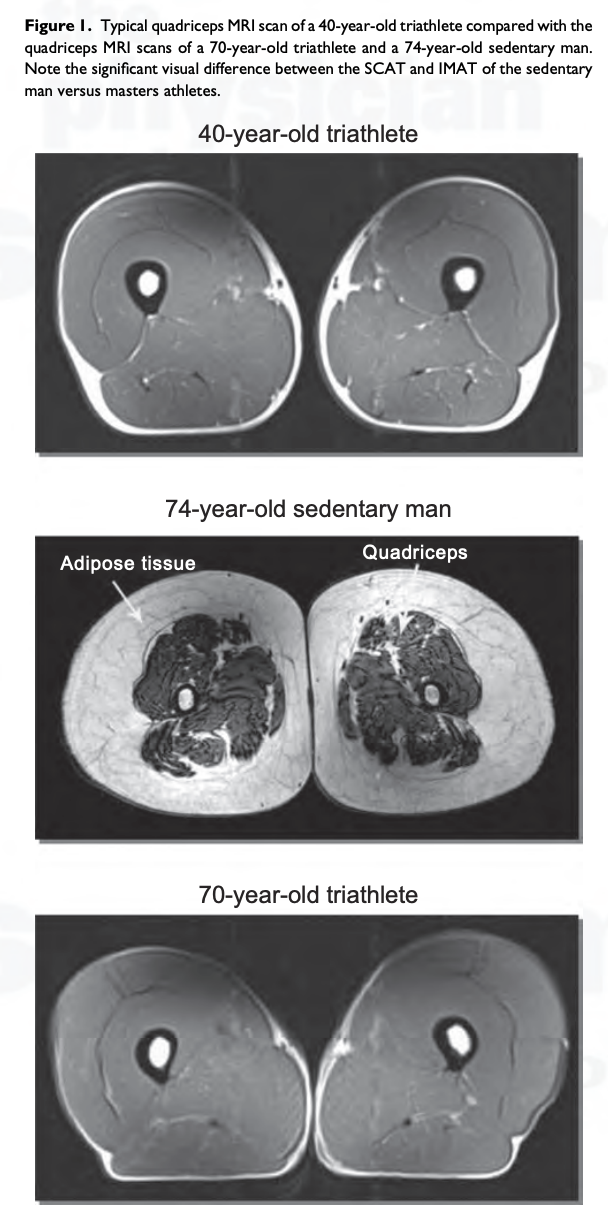
This is one of the most circulated MRI images in the fitness industry.
Top: a 40 year old triathlete.
Middle: a sedentary 74 year old man. Bottom: a 70 year old triathlete.
This is what training, or lack thereof, does to a body over time.
The protocol
The protocol
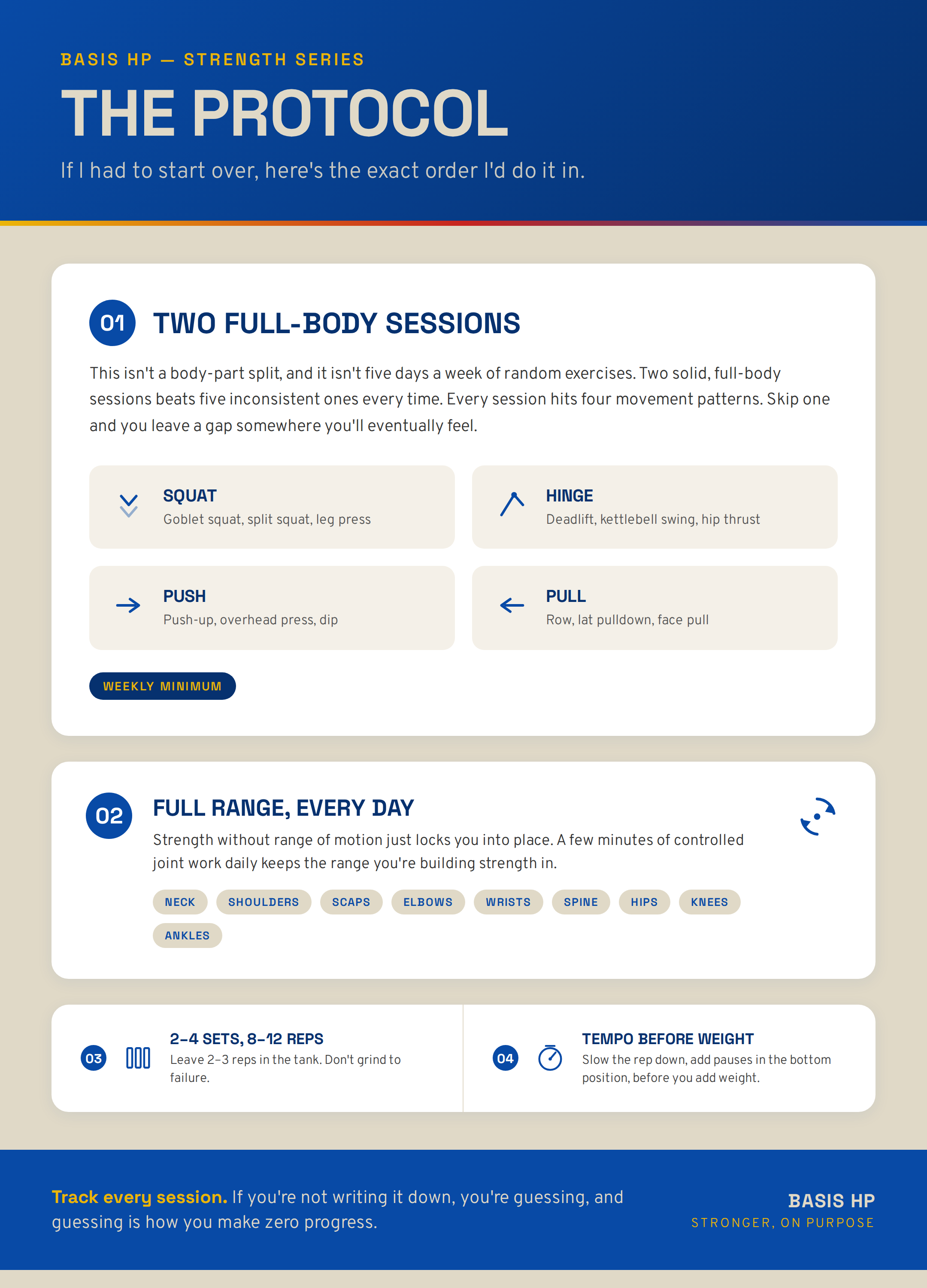
If I were starting completely over, here's the method I'd follow.
Two full-body sessions a week, minimum, hitting four movement patterns each time: a squat, a hinge (deadlift pattern), a push, and a pull. That covers almost everything your body needs to do in real life.
Move your joints through full range every day. Strength without range of motion just locks you into place. A few minutes of controlled joint work daily keeps the range you're building strength in. [free video coming — send me the link when it's ready and I'll drop it in]
2 to 4 sets of 8 to 12 reps per movement. Leave 2 to 3 reps in the tank on your last set. Don't grind to failure.
Add tempo and control before you add weight. When a weight starts to feel easy, don't just load more plates. Slow the rep down, own the full range, add a pause at the bottom. Only once that's easy too do you bump the weight, 2.5 to 5 lbs at a time.
Reframe your thinking:
This isn't about the weight on the bar. It's about being the person who can pick their grandkids up off the floor, get up and down without second guessing, and keep up on a hike at 65 the same way you did at 45.
Strength is the foundation the next 20 years of your life will rest on.
Even if you never step through our doors, do the four things above. It works.