
This is probably the number one thing we hear from clients. No matter what they do, they can't get rid of the tightness, the achiness, the stiffness.
Stretching gives you short-term relief. But it takes months of consistent stretching to change anything, and even then, that's just your passive range of motion.
If you want to feel less tight, move better, and have less joint discomfort when you're active, you need more active range of motion. Stretching isn't the wrong thing to do. It's just not the entire picture.
I've fixed this for myself and for hundreds of clients at Basis. Literally, no joke, hundreds. Here's how we do it.
Movement is how your joints get nutrition
Cartilage, the covering on the ends of your bones, has no blood supply. It's fed by the synovial fluid inside your joint capsule, and moving the joint through its range of motion is what pushes that fluid in. That's what brings nutrients to the cartilage and keeps it healthy.
A 2026 review of the research on synovial joints lays out how regular movement keeps that fluid circulating, keeps the joint lubricated, and feeds the cartilage. The more you move, the more nutrients get to your joints, and we all know nutrition matters.
Take that same movement away and your cartilage can thin fast: up to 25% within 2 years, according to this study.
All this to say: the range you stop using, you start losing.
Stretching is only half the puzzle
A review of 65 studies found stretching doesn't make the muscle longer. The gain comes from your nervous system tolerating the stretch, plus a drop in stiffness. Meanwhile, lifting through full range of motion builds just as much range.
Your body builds what you ask of it
This is a foundational principle in physiology, especially exercise physiology. It's called the SAID principle: Specific Adaptation to Imposed Demands.
If your demand is sitting at a desk 6 hours a day, you get hips built to tolerate sitting at a desk 6 hours a day. Take those same hips on a spur-of-the-moment 10K and you're asking them to do something they haven't been asked to do in months. The tissue isn't prepared for it.
The body adapts to the stimulus we give it. If most of that stimulus is sitting, starring at a screen, our joints and our movement reflect that capability.
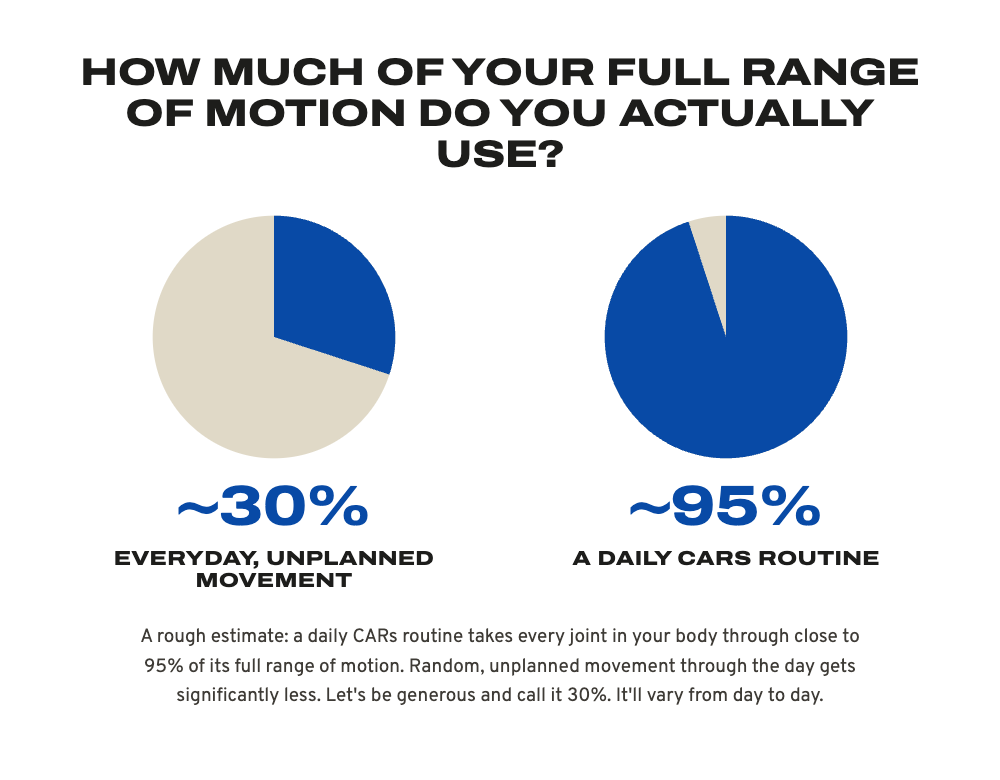
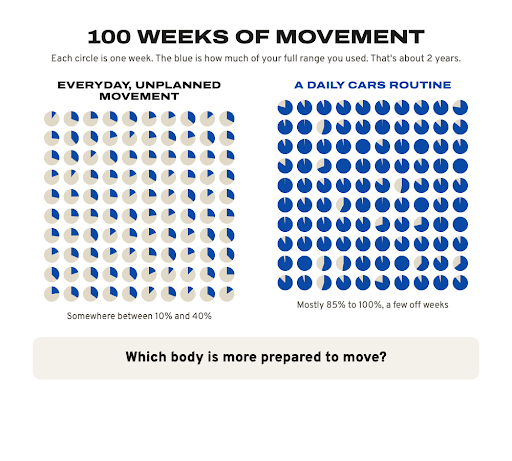
Now, move every joint through its biggest range of motion, under control, and you get joints and tissue built for movement opportunity in every direction. By movement opportunity, I mean having the option to move in ways you didn't plan, like catching yourself when you misstep on a run. We call this Movement Opportunity or in FRS: Degrees of Freedom.
This is why we do a CARs routine every single day, and it's what Kinstretch does so well. In my experience, nothing else hits it as completely. Not Pilates, not yoga, not powerlifting, not cycling. Nothing else.
Your free class
Here's a full class, on us. Try it this week and notice how things feel.
Then reply to this email and I'll help you figure out which joints need the most work.
You might even get a discounted assessment.
Links to citations:
Labusca L, et al. Motion as medicine: physical activity, joint sensitivity, and pain management. A narrative review. Medical Sciences, 2026. Link
Vanwanseele B, et al. Knee cartilage of spinal cord-injured patients displays progressive thinning in the absence of normal joint loading and movement. Arthritis & Rheumatism, 2002. Link
Ingram LA, et al. Mechanisms underlying range of motion improvements following acute and chronic static stretching: a systematic review, meta-analysis and multivariate meta-regression (65 studies, 1,542 adults). Sports Medicine, 2025. Link
Alizadeh S, et al. Resistance training induces improvements in range of motion: a systematic review and meta-analysis (55 studies). Sports Medicine, 2023. Link