
The Case for Cardio & the Number That Predicts Longevity
Every time you move, your body has to make energy. How it makes it depends on how hard you're working. Which ways you train shapes how you feel this week, and how healthy you are decades from now.
Cardio with a touch of exercise science:
Your body makes energy two ways:
Aerobically: with oxygen, in your mitochondria. Slower, but produces a lot of energy efficiently.
Anaerobically: without oxygen, in the fluid of your muscle cells, through glycolysis. This delivers energy much faster, but far less energy from the process.
You're always using both. The intensity that you’re working at decides which one leads. If this sounds familiar, it's because we designed the Basis Conditioning Programs around evidence-based exercise science... and we didn't cherry-pick the parts we like FoR MaRkEtInG PuRPoSeS (Yes, I’m talking about Orangy Theory Fitness).
Aerobic vs Anaerobic: Heart Rate Training Zones.
1. Aerobic Training (Zone 2 Training) (At Basis: AZT)
This is steady work you could hold for an hour or more. Lactate, a byproduct of glycolysis (breaking down glucose for fast energy), stays low because you clear it as fast as you make it.
Training here adds mitochondria and makes you better at burning fat and clearing lactate, which your mitochondria actually burn as fuel. Meaning, if you want to get more "fit"... low and slow cardio is key. This zone is typically around 70 to 80% of your max heart rate.
2. Threshold (TZT) (Zone 3) (At Basis: TZT)
The point where lactate production outruns aerobic clearance. This pace should feel hard, but controlled. Training here pushes your lactate threshold higher, so you can work harder for longer, but only as long as you've built an even bigger aerobic base underneath it...remember, your aerobic system is what clears that lactate.
That's the part Orangetheory ignores. Their claims are an incomplete look at the research on energy systems. Boom. Roasted. Your lactate threshold is most likely somewhere between 80 and 90% of your max heart rate.
3. VO2 max (Zone 4) (At Basis: VO2 Max)
The most oxygen your body can use. Your aerobic ceiling, driven largely by how much blood your heart pumps per beat. Trained with short, very hard intervals.
It's also one of the strongest markers of longevity we have. A higher VO2 max tracks with a longer life, with no upper limit found.
It's quite an interesting relationship... the larger your aerobic base, the (potentially) higher your VO2 max.
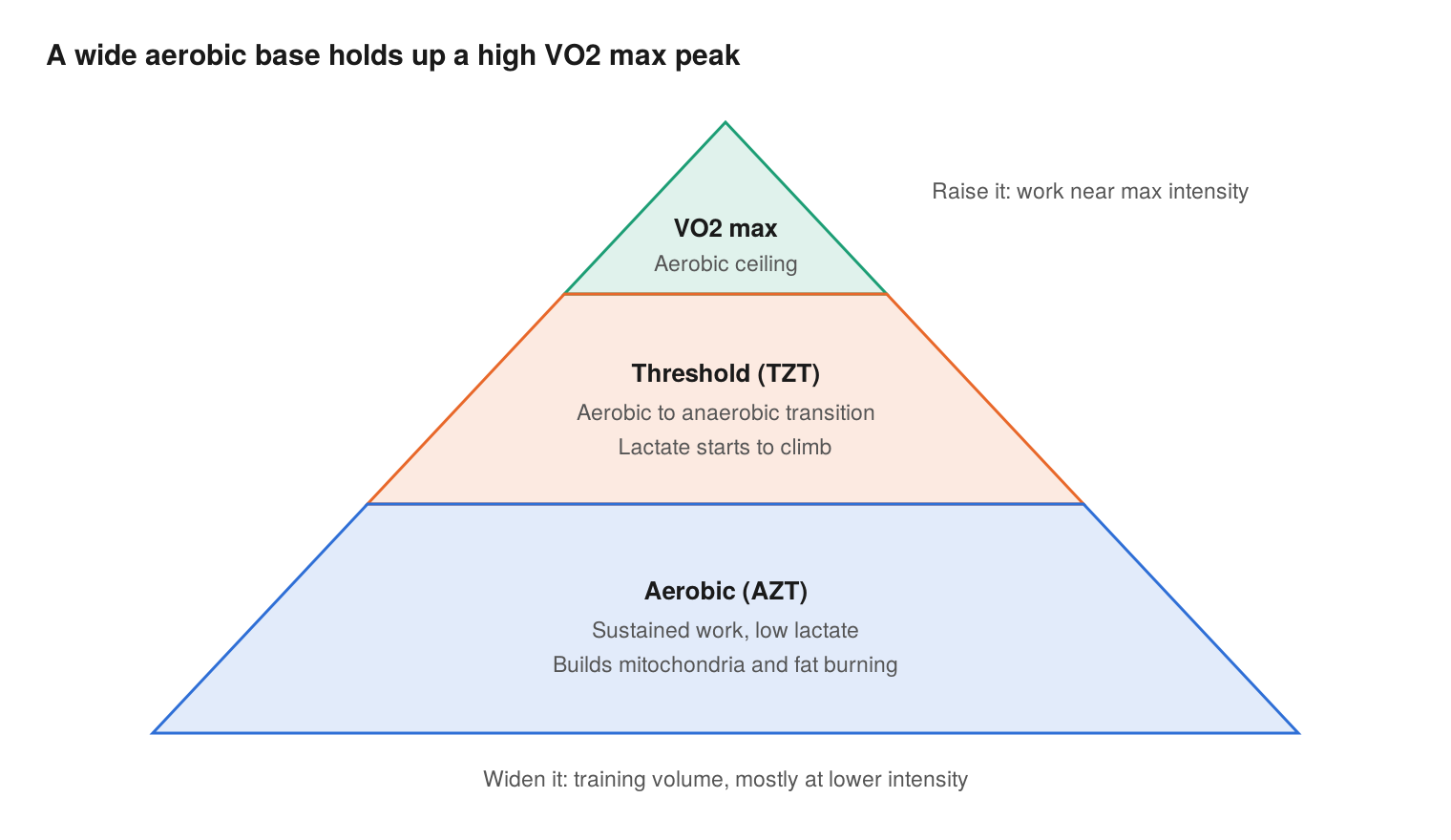
Energy System Pyramid
Ideally we see a wide base & a high peak. The base, built with lots of Zone 2 or aerobic volume, is what supports the highest peak, which is built with work near our Max HR.
Train only the top, and you get a tall, narrow pyramid with very little recovery capacity... conversely, if you never work near your max... you will compress your pyramid and heart rate zones to be much lower. Remember, a high VO2 is a marker of longevity.
Let's look at a 20+ year study on fitness in adults
Cleveland Clinic researchers looked at 122,007 adults who took a treadmill test between 1991 and 2014, then tracked them for about 8 years. They sorted everyone into five fitness groups, compared with people their own age and sex, from low (bottom 25%) to elite (top 2.5%).
The least-fit group had about 5 times the risk of death of the elite group.
Low fitness was as dangerous as, or more dangerous than, smoking, diabetes, or heart disease.
The best of the best (top 2.5% of adults) had about 23% lower risk of death than people who were already fitter than 75% of adults their age.
To say it plainly: There was no ceiling. The higher your fitness, the lower your risk. So cool!
So how do we get more aerobic capacity?
Let's start by estimating your aerobic zone
We use 208 minus (0.7 x age) for max heart rate, not the old "220 minus age." The old formula underestimates max heart rate as you get older. This one comes from a meta-analysis of 351 studies and 18,712 people.
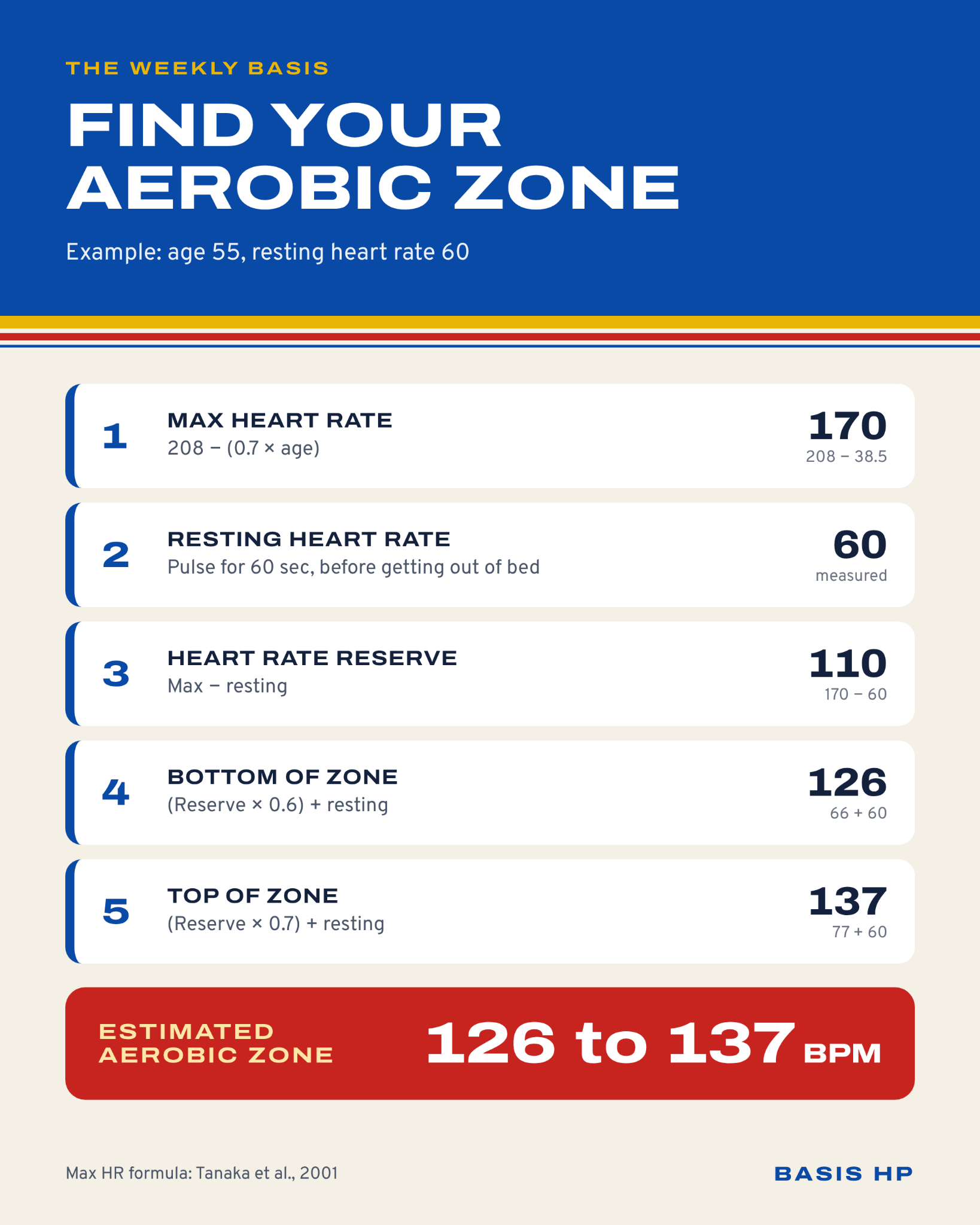
This is a ton of information about energy systems, and in the coming weeks, months, years... I plan to get into each zone and the hows, whats, and details of it all. I had to break out my old Ex Phys textbooks for this one… it was fun.
For now... let me know where your aerobic zone is, and I'll share what you can do to build it!