
This is why your nagging injuries keep coming back…
I've had some version of this conversation at least four times in the last week.
"My ___ hurts when I ___. Why?"
My hamstring hurts when I run. My hip hurts when I come to the gym. So I rest it, and it feels better. But when I go to move again, it starts hurting again. What do I do?
From where I sit, there's a big gap across the industry between physical therapy and strength training. You can do some things in the gym. Other things you just can't. And no one has really told you exactly what to do, or how to build it.
SO LET'S ZOOM OUT
Most of us think about exercise one way. Squatting makes you stronger. Cardio makes you more fit. That's true. But there's a lot more nuance.
Exercise is actually a signal you send to your body. The more specific the signal, the more specific the result.
A cranky hamstring or hip doesn't need more "leg day." It needs the right dose: strength work that matches what that tissue can handle right now. Get the dose right, and the tissue adapts. That's what lets you do more.
This is the equation I use with every client in this situation.
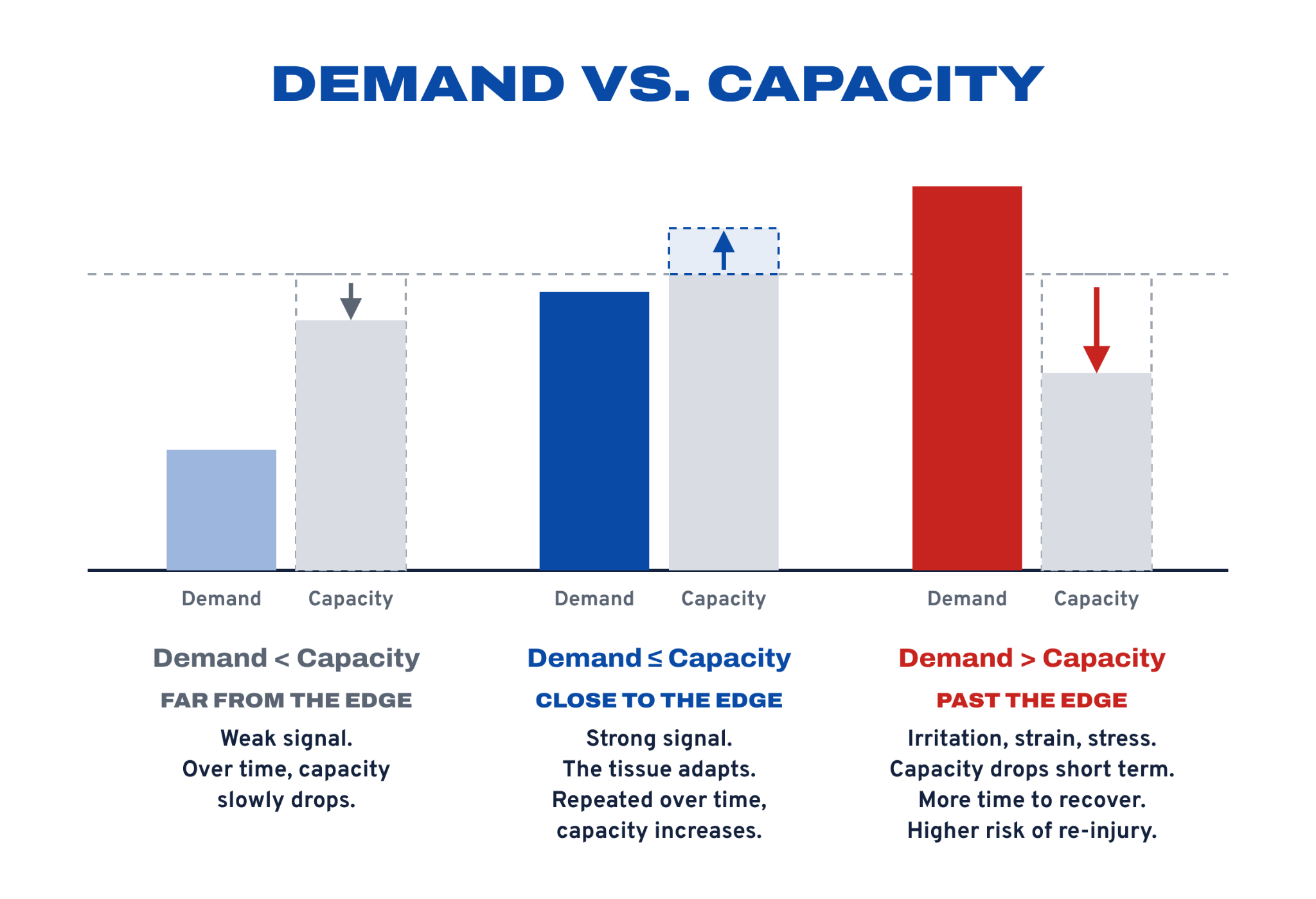
Demand ≤ Capacity = adaptation. The tissue gets stronger, in the specific ways the demand asks it to.
Demand > Capacity = irritation. Inflammation, chronic stress in the tissue, repeated injury. Repeat that enough and it becomes the nagging pain you just can't seem to get rid of.
Think of it this way. Say your best squat is 225. But every time you walk into the gym, you put 255 on the bar. Then you ask why your hips and back hurt every time you squat.
An irritated hamstring or a cranky hip is the same story. It's not literally more weight on the bar. But the demand you're giving it is beyond what that specific tissue is capable of.
The International Olympic Committee's consensus statement on training load names poor load management as a major risk factor for injury. So the job is simple to say: find what the tissue can handle, then work close enough to that edge to drive change without crossing it.
WHERE ISOMETRICS COME IN
One of the best first signals is an isometric: a hold. We use these in our Kinstretch classes, where they're called PAILs and RAILs. You push or pull against something without moving the joint.
A hold lets us control exactly how much demand a tissue gets, in a specific position, at a specific intensity. It's a really controlled environment for giving a really specific signal. That makes it much easier to stay at the edge of your capacity without overdoing it.
According to this review of 61 studies, isometric training made tendons better at handling load... and the more strain the tendon handled, the bigger the gain.
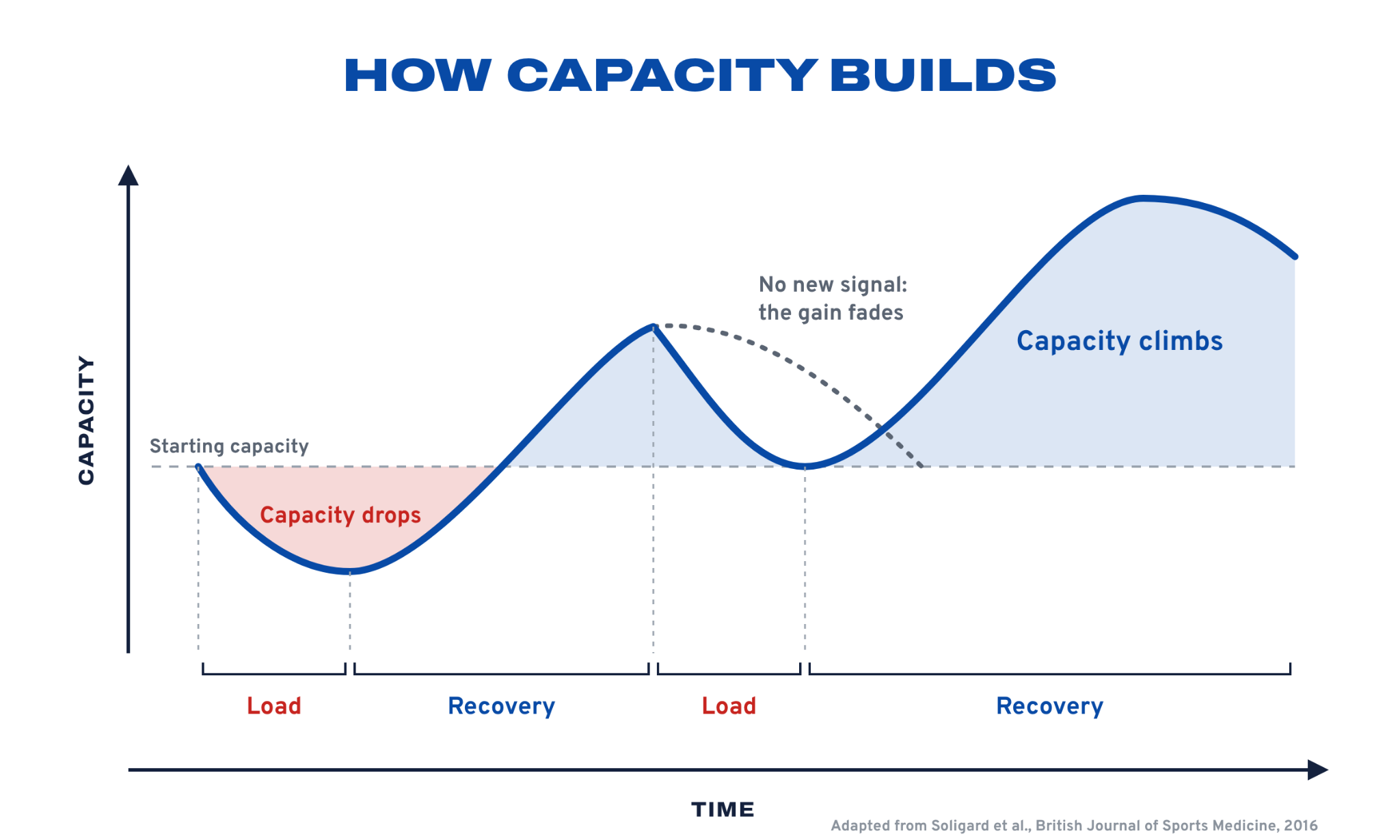
Every time you train, capacity dips first. You're a little fatigued. Then, with recovery, the tissue rebuilds slightly above where it started. Load it again at that point, and the next round starts higher. Capacity climbs, one step at a time.
Wait too long and the gain fades back to where you started. Push past the edge, or come back before you've recovered, and each round starts lower.
This is what we WANT our Demand (or Load) and Recovery curve to look like...
REST IS ONLY HALF OF IT
This is all easier said than done. And it doesn't mean rest is the solution.
Rest is part of the equation. We need it, because that's part of recovery. The missing piece is doing the right exercises in between.
If we hurt our hamstring running, we rest. Then we go run again. But we haven't given that tissue any signal other than rest. So when we run, that tissue says, "I haven't been prepared for this."
This is why we started coaching Kinstretch more than a decade ago, and why we still do CARs every single day. They show us where our joints and tissues actually are. They're a diagnostic tool that helps you (and your coach) see what's going on, and a long-term joint health tool. And they help us train with a signal specific enough to match.
If you're stuck in the space between injury recovery and strength training, reply to this email. Tell me what's going on and what you can't do yet, and I'll help you start.
Sources
Soligard T, et al. How much is too much? (Part 1) International Olympic Committee consensus statement on load in sport and risk of injury. British Journal of Sports Medicine, 2016. Also the source of the How Capacity Builds curve (Figure 1, redrawn). bjsm.bmj.com/content/50/17/1030
Lazarczuk SL, et al. Mechanical, material and morphological adaptations of healthy lower limb tendons to mechanical loading: a systematic review and meta-analysis. Sports Medicine, 2022. 61 studies, 763 participants. All contraction modes, including isometric, increased tendon stiffness; "high-strain protocols induced larger increases in tendon stiffness than low-strain protocols." link.springer.com/article/10.1007/s40279-022-01695-y